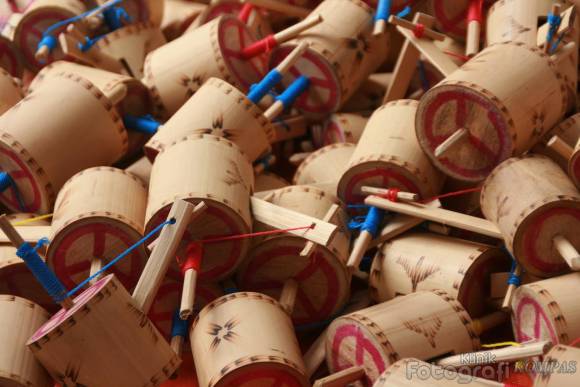
Pink Fire Pointer Batik
Showing posts with label culture. Show all posts

Batik, Indonesian Cultural Heritage

 Do you know Batik ? 
Obama With His Batik Cloth
Batik is an activity to write an images on certain media that formed a pattern of its own. The 'Batik' word usually refers to a cloth with a pattern of material produced by wax-resist dyeing. 

Historically, in ancient time, membatik (making the batik)  is a skill that commonly owned by women. But eventually it becomes a livelihood for them. 

Originally, Batik is still manually or using hand (using a tool called canthing). However, at this time batik also developed with stamped or machine. Currently in Indonesia, Batik is a thing that very advanced. Many children and school in Indonesia also has taught their students to learn about batik and the indonesian goverment also has set 2nd October as National Batik Day. 

Sulawesi Batik
Bali Batik Motif
Pesisir Batik Motif
Keraton Batik
East Java Batik Motif
In Sumatera, Borneo, Java and Bali you can find different Batik patterns in each region.

Membatik Process


Currently, Indonesian Batik (ranging from the techniques, technology, motifs development and culture) set as Masterpieces of the Oral and Intangible Heritage of Humanity since 2 October 2009 by UNESCO. 


Pict Source:
http://agvnk-0n3.blogspot.com/2012/06/pengertian-dan-sejarah-seni-batik.html
http://ndaqrnamaniez.blogspot.com/2013/01/datanglah-ke-indonesia-untuk-belajar.html
http://senirupasmasa.wordpress.com/2012/07/25/motif-batik-nusantara-secara-umum/
http://frexpaper.com/batik-saver-screen-flower-pattern-wallpaper-wallpapers-phone.html

Reog, The One Of The Cultural Arts From Indonesia

Reog is one of the cultural arts from East Java and the northwestern part Ponorogo Reog regarded as the hometown of the real. Roxburgh town gate was decorated by the figure warok and gemblak, two figures who have appeared at the time reog performed. Reog is one of the local culture in Indonesia is still very strong with things mystical and powerful mysticism.

Modern Reog usually performed in several events such as weddings, circumcisions and the great days of the National. Reog Ponorogo art consists of a series of 2 to 3 opening dance. The first dance is usually performed by 6-8 valiant men dressed all in black, with red polished face. The figure depicts the lion dancers are brave. Next is a dance performed by girls who ride horses 6-8. In the traditional reog, dancers are usually performed by male dancers dressed in women. This dance is called a braid or Jathilan horse dance, which should be distinguished from other dances that lumping horse dance.

Other opening dance if there is usually a dance by a little boy who brought the funny scene called Bujang Ganong or Ganongan.

After the opening dance is complete, the new core scenes whose content is displayed depends reog condition where art is displayed. When it comes to marriage, the romance scenes are displayed. For the celebration of circumcision or circumcision, is usually the story of warriors,

Art scene in reog usually do not follow a neat scenario. Here there is always interaction between players and masterminds (usually the leader of the party) and sometimes with the audience. Sometimes a player's performances can be replaced by another player when the player's fatigue. The first importance in the staging of art reog is to give satisfaction to the audience.

The final scene is a barong lion, where the actors wear masks shaped head of a lion with a crown made of peacock feathers. Weight mask can reach 50-60 kg. Heavy mask is carried by the dancers with his teeth. The ability to bring masks are obtained in addition to weight training, is also believed diproleh with spiritual exercises such as fasting and penance.

Tay Kak Sie Temples in Semarang, The Great Heritage From Cheng Ho

Sam Po Kong Temple is a heritage, the former site of the first port of call and landing a Chinese Moslem Admiral named Zheng He / Cheng Ho. Located in Simongan area, southwest of the city of Semarang. Signs that indicate the former petilasan keislamanan characterized by the discovery of writing reads "Let us a moment of silence to listen to readings of the Qur'an".

Gedung Batu called because its shape is a huge Batu Caves are situated on a rock hill., An Indonesian Chinese descent consider that the building is a temple - remember the architectural shape that resembles a Chinese pagoda. Now the place is used as a memorial and a place of worship or worship as well as a place for pilgrimages. For this purpose, in the cave were placed on an altar stone, and statues of Sam Po Tay Djien. Though admiral cheng ho is a Muslim, but by god they are considered. It can dimeklumi remember Confucianism or Tau consider a person who has died can provide help to those.


According to the story, Admiral Zheng He was sailing through the sea of Java there is a sick crew, he ordered the anchor. Then he was close to the northern coast of Semarang and founded a mosque on the waterfront which has now been changed into a temple. The building now has been at the center of the city of Semarang on the northern coast of Java akibatkan always mangalami siltation caused the sediment so that the land would gradually growing wider towards the north.

That said, after Zheng He fled the scene because he had to continue his voyage, his crew, many who live in the village Simongan and mating with the locals. They bersawah and farming on the ground. Zheng He gave a lesson about planting and spreading the teachings of Islam.

Batik a Masterpieces of the Oral and Intangible Heritage of Humanity

Batik is one way of making fabric. Besides batik can refer to two things. The first is the technique of coloring cloth using the wax to prevent staining part of the fabric. In the international literature, this technique is known as a wax-resist dyeing. The second notion is a fabric or clothing made ​​with these techniques, including the use of certain motifs that its uniqueness. Batik Indonesia, as the overall engineering, technology, and development-related motives and culture, UNESCO has been designated a Masterpieces of the Oral and Intangible Heritage of Humanity since October 2, 2009.


The word "batik" comes from the combination of two Javanese word "amba", meaning "writing" and "titik" which means "point".


Batik is a craft that has high artistic value and has become part of the culture of Indonesia (particularly Java) since long. Javanese women in the past made their skills in batik for a living, so that in the past, batik work is exclusively women's work to finding "Batik Cap" which allows the entry of men into the field. There are some exceptions to this phenomenon, namely the coastal batik has the masculine lines as can be seen in shades of "Mega Clouds", which in some coastal areas batik work is common for men.


Tradition of batik was originally a tradition for generations, so that sometimes a recognizable motif batik originated from a particular family. Some batik motif could indicate a person's status. Even today, some batik motif tadisional only used by the family palace of Yogyakarta and Surakarta.


A variety of shades and colors of Batik is influenced by various foreign influences. Initially, batik has a variety of shades and colors are limited, and some patterns may only be used by certain circles. But batik coastal absorb various external influences, such as foreign traders, and also in the end, the invaders. 


Bright colors like red popularized by the Chinese, who also popularized the phoenix pattern. European colonial nations also took an interest in batik, and the result is a style unknown before flowers (like tulips) as well as objects brought by the colonizers (buildings or horse-drawn carriage), as well as their favorite colors such as blue. Retain traditional batik coraknya and is still used in traditional ceremonies because each style usually has a representation of each.


Batik was originally made ​​on material with a white cotton cloth called. Today batik is also made on other materials such as silk, polyester, rayon and other synthetic materials. Motif formed by a liquid wax using a tool called a canting for subtle motif, or a brush to a large motif, so that the liquid wax to seep into the fabric fibers. Fabrics that have been painted with wax and then dyed with the desired color, usually starting from the light colors. Immersion and then taken to another motif with color or black older. After some time the coloring process, which has dibatik cloth dipped in chemicals to dissolve the wax.

Barong Dance, Mirror Of Human Eternal Struggle

Barong Dance is the most popular art shows and in demand by tourists in Bali such as Uluwatu Kecak Dance. Not to be complete vacation to Bali, before watching the show this quality art.

Barong dance is a traditional Balinese dance repertoire derived from pre-Hindu culture. The dance depicts the battle between righteousness (dharma) and falsehood (adharma). Form by virtue dilakonkan Barong, a dancer with a costume that is a quadruped, while being played by Rangda sleaze, that is a scary figure with two pointy fangs in his mouth.

There are several types of Barong Dance which is shown on the island of Bali, among them the Barong Ket, Barong Bangkal (pig), Elephant Barong, Barong Dog (dog), Barong Brutuk, and Barong-Barongan. However, among the types of Barong is most often a tourist treat is the Barong Ket, Barong Keket or who have a fairly complete costume and dance.

Barong Ket costume is generally described the combination of a lion, tiger, and ox. In the body is decorated with ornaments from the skin, pieces of mirror glass, and also features the feathers of pandanus fiber. Barong is played by two dancers (saluk interpreter / interpreter Bapang): one dancer took up positions in front of the play movement of the head and front legs Barong, while the second dancer at the back of the hind legs and tail plays a Barong.

At first glance, Barong Ket is not much different from the Lion Dance is usually performed by the Chinese community. It's just that, stories that are played in this show is different, the story of the fight between the Barong and Rangda are equipped with other figures, such as the Apes (Barong friend), Dewi Kunti, Sadewa (Dewi Kunti's son), and the followers of Rangda.

Serune Kalee, An Acehnese Traditional Musical Instruments That Are Becoming Obsolete

Serune Kalee is a traditional wind instruments Aceh is a typical traditional Acehnese musit tool capable of steady incredible instruments that accompany the songs and heroic calm nan who has grown old and lived by the people of Aceh since the days of the kingdom-the kingdom of Aceh until now. 


This instrument is popular in the area of ​​Pidie, North Aceh, Aceh Besar and Aceh Barat. This instrument is usually played in conjunction with the Gendrang Rapai and entertainment events, dances, welcoming guests of honor at the king of kings kingdom of the golden age of Aceh Darussalam.

Kalee Serune together with geundrang and Rapai is suatau perangkatan music since the heyday of Aceh Darussalam kingdom until now remained to decorate / color the music sector in Aceh's traditional culture. Serune Kalee is one of the traditional wind instrument of Aceh. This instrument is one of the flute or clarinet, spread in the Malay community.


Kalee Serune word refers to two different things. The first word, pointing to the brass Serune traditional Acehnese who often played together Rapai. While Kalee is the name of a village name in Laweung, Pidie. Thus, Serune Kalee Kalee has the meaning of fife. Giving the name may be associated with the manufacture or appearance.

Music equipment is not only used by people of Aceh, but also the Minangkabau, Agam, and several other areas in West Sumatra. In fact, the distribution of these supplies reach Thailand, Sri Lanka, and Malaysia. This kind of musical instrument is also found in other coastal areas of Aceh Province and, as Pidie, North Aceh, Aceh Besar, Aceh and West with a similar name (Burhan Paradise, ed., 1986: 81). Each region who use this kind of music gives a wide range of variations in the equipment, so that the shape and its name was also mixed. However, among the several variations serune, there are similarities in the feel of a raised voice, the barrel of a tone, vibration, sound volume, the dynamics of his voice.


This equipment has elongated straight round and round. The top of this equipment are small, then grow until the end of the bottom. In the body there are holes for the fingers with a large enough size. The very bottom of this equipment is growing like lotus petals. Enough to carry this equipment put into bags that were binding on the reins of the fabric, then carried on the shoulder.

Based on existing data, this equipment has been around since the advent of Islam to Aceh. There are some who say this equipment came from China (ZH Idris, 1993: 48-49). Regardless of the assumption, in fact does Aceh kingdom in ancient times is open. It results in Aceh are visited by merchants from various overseas territories. In the reign of Sultan Iskandar Muda (1607-1636), Aceh has a prominent position.  


At this time of culture in Aceh is also growing rapidly, one of which is the arts, with a strong Islamic style. Serune Kalee equipment still current plays an important role in various performing arts, in various ceremonies, and other events. Kalee Serune music games have been entertaining the people of Aceh since the first until now.

Rambu Solo, Tana Toraja Culture, A World Cultural Heritage

Tana Toraja is one area in Indonesia is still thick with custom. Tana Toraja is about 350 km north of Makassar, spent eight hours using a personal vehicle mileage want any public transportation. 
One legacy of the tradition of Tanah Toraja is Rambusolo ceremony. Rambusolo is a ceremony intended to honor the spirits of the dead and bring the world into the spiritual realm, which is returned to immortality with their ancestors in a resting place.  

The ceremony is often also called the consummation ceremony of death, because new people are considered dead really dead after all this ceremonial procession fulfilled. If not, then the people who died are only considered as the "sick" or "weak", so he's still treated like a living, which was laid in bed and given a dish of food and beverages, and even talk to. 

Therefore, local people consider this ceremony is very important, because the perfection of this ceremony will determine the position of the spirit of the deceased, whether as a haunting ghost, the ghost who reach the level of deity, or a patron god. So the ceremony Rambusolo become a "liability", resulting in any way Tana Toraja people hold it as a form of devotion to their parents who had died. 

The culmination of the event with a ceremony called Chain Rambusolo implemented in a particular field. In this ceremony there is a series of rituals that always attracted the attention of visitors, such as wrapping the corpse, placing ornaments of gold and silver thread on the coffin and the corpse to the resort pengusungan 

Interestingly, the buffalo are slaughtered in a very unique and is a hallmark of the people of Tana Toraja, which cut the throat of a buffalo with a single blow. Types of buffalo are slaughtered buffaloes was not unusual, but the albino buffalo (tedong Bonga). The price of tens of millions to hundreds of millions of rupiah per tail.

Ngaben, The Cremation Procession In Bali

Ngaben is a purification ceremony atma (soul) as the first phase of Balinese Hindu sacred obligation of his ancestors with burial procession. As I wrote in the article about yadnya Pitra, the human body consists of a rough body, subtle bodies and karma. Coarse human body is formed of five elements which are called Panca Maha Bhuta the Earth (solid), apah (liquid), Teja (hot substance) wind (air) and akasa (space). The five elements are fused to form human physical and driven by the atma (soul). When a man dies who dies is just a rough body, not his atma. So cremation is a purification process atma / soul leaving the body rough.

There are several opinions about the origin of the word Ngaben. Some say Ngaben of Beya word which means lunch, there is also a reply saying the word ngabu (ashes), etc..


In Hinduism it is believed that Lord Brahma the creator god as well as also is the god of fire. So cremation is a process of purification of the spirit by using the means of fire so they can go back to the creator of Brahma. The fire is the fire which is used to burn the bodies of concrete and abstract form fire spells to her pastor pralina of burning impurities inherent in atma / soul.

Cremation ceremony or ritual Pelebon often referred to those who died, are considered very important, busy and vibrant, because the family was able to liberate pengabenan spirit of the deceased from earthly ties to heaven, or transformed back into the world through rienkarnasi. Because of this ceremony requires effort, cost and length of time and large, this is often done so long after death.

To bear the burden of costs, labor and others, now people often do pengabenan mass / together. The bodies of the dead are buried before fees sufficient, but for some families that can afford cremation ceremony can be performed as soon as possible to keep the bodies of people who have died at home, while waiting for a good time. During the period of storage in the house, the spirits of the dead became restless and always want freedom.

Good day is usually given by the priests after consultation and existing calendar. Preparation is usually taken away before the day of well-defined. At the time of preparing this family "and bade bulls" made ​​of bamboo, wood, paper of various colors in accordance with the class or socioeconomic status families concerned.

Gamelan, Symbol Of The Indonesians Cultural Wisdom

Gamelan is a musical ensemble that usually highlight metallophones, xylophone, drums, and gongs. The term gamelan refers to the instrument / tool, which is a unified whole that is realized and sounded together. The word itself comes from Gamelan Java language gamel which means hitting / beating, followed by an ending that makes it a noun.  


Gamelan orchestra mostly located on the island of Java, Madura, Bali, and Lombok in Indonesia in various types of ensemble sizes and shapes. In Bali and Lombok today, and in Java through the 18th century, the term is considered synonymous with the gong more gamelan.
Preceded the emergence of gamelan with Hindu-Buddhist culture that dominated Indonesia in the early days of recording history, which also represents the original Indonesian art. Instrument was developed to shape up like this at the time of the Majapahit Kingdom. In contrast to the music of India, the only impact of the India-an in gamelan music is how menyanikannya. In Javanese mythology, the gamelan dicipatakan by Sang Hyang Guru in Saka Era, the god who controlled all the land of Java, with a castle on the mountain Mahendra in Medangkamulan (now Mount Lawu). Sang Hyang Guru is first created the gong to summon the gods. For a more specific message and then create two gongs, then eventually formed gamelan set.
The description of the ensemble's first musical instrument was found in the temple of Borobudur, Magelang, Central Java, which has stood since the 8th century. Musical instruments such as bamboo flute, bells, drums in various sizes, harp, stringed musical instrument that is swiped and learned, is found in the relief. However, little is found elements of metal musical instruments. However, the relief of the instrument is said to be the origin of the gamelan.
Tuning and making gamelan orchestra is a complex process. Gamelan using a four-way tuning, the slendro, slendro, "gamelan" (special area of ​​Sunda, or West Java), and "madenda" (also known as the diatonic, the same as the original minor scale that is widely used in Europe.
Gamelan music is a combination of the influence of foreign art that diverse. Not regard the tone of Chinese musical instruments of Southeast Asia, drum band and move to music from India, bowed strings of the Middle East, Europe and even the military style that we hear the traditional music of Java and Bali today.
The interaction component is loaded with melody, rhythm and timbre to maintain the glory of Balinese gamelan orchestra music. The pillars of this music brings together a range of rural community character of Bali is the typical order of music which is an inseparable part of everyday life.

Wayang, Javanese Cultural Heritage Masterpieces Of Art

Wayang is a performing arts thriving native Indonesia in Java and Bali. UNESCO, in charge of cultural institutions of the United Nations, on 7 November 2003 set as the wayang shadow puppet show of the famous Indonesia, a world heritage priceless masterpiece in the art speak (Masterpiece of Oral and Intangible Heritage of Humanity).  

Actually, puppet shows not only in Indonesia. Many countries have a puppet show. However, performing shadow puppet (wayang) in Indonesia has its own style of speech and keunikkan, which is a genuine masterpiece of Indonesia. And to put it into the UNESCO's World Heritage List in 2003. 

There was no evidence to suggest wayang existed before Hinduism spread in South Asia. It is estimated performing arts brought in by Indian traders. However, the local genius, culture that existed before the entry of Hindus together with the development of performing arts coming to give its own color on the performing arts in Indonesia. Until now, the early records that can be obtained about puppet shows from inscriptions Balitung in Century 4, which reads "the Galigi mawayang" 

When the Hindu religion in Indonesia and adjust the existing culture, art show to be an effective medium to spread the Hindu religion, where puppet shows using the story of Ramayana and Mahabharata. 

Similarly, when the advent of Islam, when the show featuring "God" or "God" in human form is prohibited, came the puppets made of cowhide, which is now just a shadow watched the show alone, we now know as shadow puppets. 

To propagate, grow well Sadat puppets that introduce Islamic values. 

Even when the Catholic missionary, Father Timotheus L. Wignyosubroto SJ in 1960 in its mission to spread the Catholic religion to develop Puppet Revelation, which is the source of the story comes from the Bible.

Gasing, An Indonesian Traditional Games, Inherited Wisdom Of The Ancestors

Gasing is one of the traditional game of the Indonesia archipelago, although the history of its spread is not known with certainty.
 
In the region of Seven Islands (Natuna), Riau Islands, a top game has been around long before the Dutch colonization. While in North Sulawesi, tops known since the 1930s. The game is done by children and adults. Typically, performed in the courtyard of a house and a flat hard soil conditions.  

The game tops can be done in person or team with the number of players varies, according to the custom in their respective areas.

Until now, the top is still very popular to do in some areas in Indonesia. Even residents of the islands Rian a competition routine. While in Demak, usually played during the turn of the tops of the rainy season to dry season. Bengkulu community busy playing kazoos during the celebration of the Islamic New Year, 1 Muharram.


Some areas have different terms to refer to a top. People of West Java and Jakarta called gangsing or panggal. Menamaninya lemur community Lampung, East Kalimantan residents call begasing, whereas in the Maluku called Apiong and in the West Nusatenggara named Maggasing.  

Only the people in Jambi, Bengkulu, West Sumatra, Riau Islands Tanjungpinang and calling gasing. Maggasing name or well known community aggasing Bugis in South Sulawesi. While the Bolaang Mongondow in North Sulawesi region known by the name Paki. East Java called top people as kekehan. While in Yogyakarta, a top called with two different names. If made ​​of bamboo called gangsingan, and if made ​​of wood named pathon.